
Why choose Druid?
- Four combat roles on one character, with distinct equipment and talent needs.
- Forms offer different answers to movement, damage and survival.
- The current Feral tree connects threat, critical attacks and resource management.
- Restoration offers periodic healing and Swiftmend; Balance provides a separate caster path.
Tradeoffs
- Several forms and resources increase the learning load.
- A Cat talent plan is not automatically a complete Bear setup.
- Changing roles still requires suitable equipment and practice.
Druid · Spec
| Spec | Role | Reason |
|---|---|---|
| Balance | DPS | Spellcasting and periodic effects, with Moonkin Form deeper in the tree. |
| Feral (Cat) | DPS | Energy and combo-point damage in Cat Form. |
| Feral (Bear) | Tank | Rage, threat and survival in Bear Form. |
| Restoration | Healer | Periodic healing and planned recovery. |
Solo exploration
Our starting suggestion if movement, melee and a defensive form appeal to you.
Dungeon tank
Focus on Bear threat and survival, then coordinate control with the group.
Group healer
A fit for preparing periodic healing rather than only reacting.
Ranged nature caster
Choose the caster routine itself, without treating a forecast as measured damage.
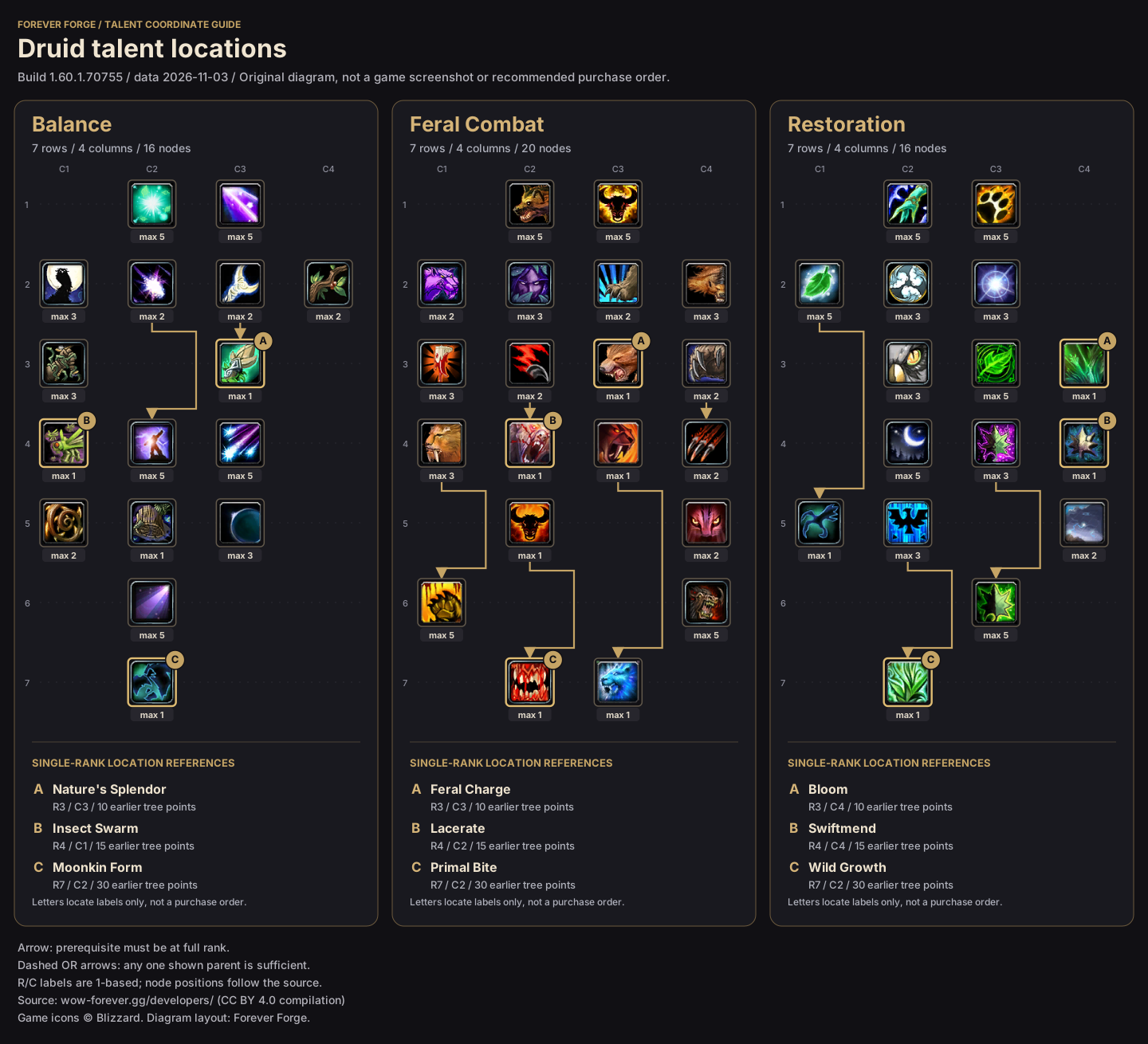
Talent location map
Original diagram of the reference trees. Locations and prerequisites are shown; this is not a recommended purchase order. Talent names follow the English export.

WoW Forever Druid Guide · Leveling
Learn one form at a time
- Practice form changes and returning to the correct action bar.
- Keep a reachable route for self-healing and regrouping.
A role switch helps only when it does not make you lose control of the fight.
Build for the attacks you use
- Inspect Ferocity and each talent's separate Cat/Bear effects.
- Check Feral Swiftness and prerequisites before planning deeper purchases.
Read current tooltips rather than copying a role label.
Separate your role plans
- Name and save a Cat plan and a Bear plan separately.
- For healing, inspect Swiftmend's current condition and Wild Growth's targeting.
Older previews and the current export differ on some nodes.
Choose a job before choosing every option
Druid is a useful choice when you want to discover which role you enjoy without immediately starting another character. It is a less direct fit if you want one fixed bar and very few decisions. Name the job you will do during your next session: solo questing, tanking for friends or healing a group. That tells you which tooltips to inspect and which equipment to keep. It also prevents flexibility from turning into several half-finished plans.
Cat and Bear should not be treated as separate talent trees. Our comparison lists them separately because melee damage and tanking are different tasks; the planner correctly shows one Feral Combat tree. Some points help both forms, while others answer a specific threat or damage problem. Put the intended role in a saved build's name so that its purpose is still clear when you reopen it.
Make leveling decisions you can explain
When ordinary enemies feel slow, first ask whether your points improve the attacks you actually use. When movement and recovery cost more time than combat, inspect resource and movement choices before adding another narrow damage bonus. These are practical decision rules, not a tested fastest-leveling order. Use the leveling-order panel to make your intended sequence visible and reversible.
Restoration deserves a separate plan if friends expect you to heal. Periodic healing makes awareness of upcoming damage valuable. Balance is equally valid as a preferred caster style, but a tier-list letter cannot guarantee how your own character performs. Read the current version and choose the task, equipment and routine together.
Common mistakes and how to fix them
Copying old powershifting instructions unchanged.
Read the current Furor and Shifting Power text and revisit resource flow.
Expecting one equipment set to cover every role.
Keep a primary-role set and inspect what a role change actually needs.
Repeating blanket claims about Druid control.
The current export gives Feral Charge an interrupt effect. Check the specific form and talent.
Race & class combinations
Skyborne faction variants are separate options; do not merge their class lists.
| Alliance | Horde |
|---|---|
| Night Elf, Skyborne High Order | Tauren, Skyborne Windshaper |
Common questions
Are Cat and Bear separate trees?
No. Both use Feral Combat. They appear separately in role comparisons because damage and tanking require different decisions.
Is this a tested fastest-leveling build?
No. These are practical recommendations from the published toolkit and current export, not a timed leveling record.
Why do old guides show different nodes?
They may use older builds. The planner's current version and node text take priority over copied positions.
Which Druid route should I inspect for a first character?
Inspect Feral Cat if you want melee, movement and access to a defensive form. Choose Balance if casting is the attraction, or prepare Restoration when healing friends is the agreed job. These are play-style suggestions, not a measured leveling order.
Which races can play Druid in WoW Forever?
The official matrix lists Night Elf and High Order Skyborne for the Alliance, and Tauren and Windshaper Skyborne for the Horde. Keep the Skyborne variants separate when checking other class combinations.
What should I change after a difficult Druid pull?
Identify whether the problem was an extra enemy, the wrong form bar, equipment or resource use. Practice reaching the needed defensive or healing action, then adjust only the relevant part of the saved plan rather than rebuilding every role at once.
Sources
- Create the Hero You Want to Be · Checked 2026-11-04
- Hunter and Druid Class Deep Dives · Checked 2026-11-04
- Talent export: 1.60.1.70755 · Checked 2026-11-04
- Druid guide (structure reference) · Checked 2026-11-04