
Why choose Paladin?
- Three group roles without creating another character.
- Healing and defensive tools give several ways to recover from a difficult fight.
- The Seal and Judgement system ties support and combat decisions together.
- The current trees offer clear role-specific milestones rather than only passive bonuses.
Tradeoffs
- A durable character is not a substitute for checking the pull and mana.
- Healing, tanking and damage plans need different equipment and expectations.
- The published class design deliberately retains limited ranged control; do not assume another tank's full toolkit.
Paladin · Spec
| Spec | Role | Reason |
|---|---|---|
| Holy | Healer | Direct healing with Holy Shock and deeper group-healing choices. |
| Protection | Tank | Holy threat, a shield and layered defensive decisions. |
| Retribution | DPS | Weapon attacks, Seals and Holy damage. |
Melee-first questing
Our starting suggestion if you want weapon combat while retaining class support.
Dungeon tank
Build around threat and survival instead of assuming a leveling damage plan is enough.
Dedicated healer
Inspect direct healing and current group-healing conditions with a separate equipment plan.
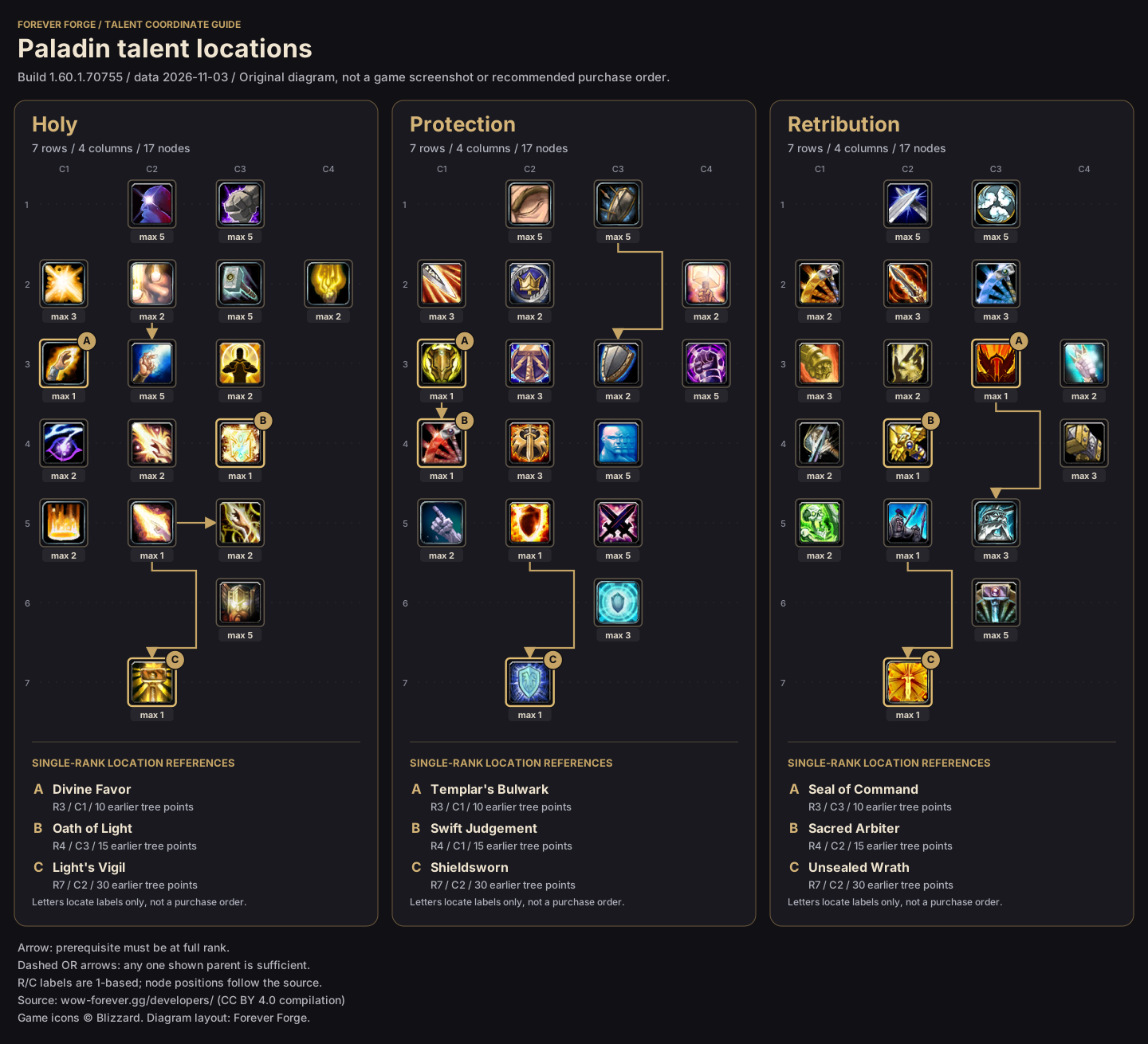
Talent location map
Original diagram of the reference trees. Locations and prerequisites are shown; this is not a recommended purchase order. Talent names follow the English export.

WoW Forever Paladin Guide · Leveling
Understand the Seal routine
- Read how your current Seal interacts with Judgement.
- Keep healing and defensive buttons reachable without losing the enemy target.
A simple melee loop becomes useful when support actions remain available.
Choose the next job
- Inspect Retribution for a melee-first plan, Holy for a healing commitment and Protection for tanking.
- Follow current node locations; the latest Protection milestones differ from older guides.
Mixing three goals too early makes it hard to tell what a point accomplishes.
Prepare a role-specific setup
- Agree whether you are tanking, healing or dealing damage before entering.
- As tank, inspect threat tools and defensive conditions; as healer, plan mana and target priorities.
Class flexibility is strongest when the party knows which job you are doing.
Start with the role your friends will expect
Paladin works well for someone who wants a recognizable melee routine and the possibility of helping in more than one way. That does not mean one build should attempt every role at once. If your next session is solo questing, begin with the attacks and recovery you use repeatedly. If friends expect you to heal or tank, create a plan named for that job and keep suitable equipment instead of relying on the class label.
Learn the relationship between Seals and Judgement before copying a long priority list. It is the class's own system and explains why support actions and combat cannot be treated as entirely separate games. A forgiving-looking toolkit can still leave you short of mana or out of position. Use the available recovery deliberately, and keep an exit or regrouping plan for difficult pulls.
Read the current tree before choosing a milestone
Paladin is a particularly clear example of why version labels matter. Earlier official articles and the reference competitor describe a different arrangement of major nodes. The export used here places Oath of Light in Holy, Shieldsworn deep in Protection and Unsealed Wrath deep in Retribution. Read the current tooltip and prerequisites rather than using an old screenshot to decide where a saved point belongs.
For group play, agree your responsibility before the first pull. A tank should understand how threat and defensive conditions interact; a healer should know who needs sustained attention and when mana allows extra actions. A melee build should contribute its support without assuming that every emergency belongs to someone else. These are practical role recommendations. They do not establish Paladin as the strongest class or prove any raid position before comparable live evidence exists.
Common mistakes and how to fix them
Copying a talent position from an old screenshot.
Use the current build: Protection now has Shieldsworn as its deepest milestone, not the old layout.
Spending mana as if recovery were free.
Watch the whole pull and keep enough for your agreed support job.
Assuming a damage plan automatically makes a tank.
Check threat, defensive prerequisites and equipment before taking that responsibility.
Race & class combinations
Undead Paladin is a Forever option in the official race/class matrix.
| Alliance | Horde |
|---|---|
| Human, Dwarf | Undead |
Common questions
Can the Horde play Paladin?
Yes. The official Forever matrix includes Undead Paladins.
Should I split points evenly across the three trees?
Not by default. Choose a primary task and a useful milestone, then justify any supporting branch.
Why does this planner differ from an old Paladin guide?
The current export changes several major nodes and positions. Follow its build label and prerequisites rather than an older screenshot.
Which Paladin specialization fits each group role?
Holy is the healing path, Protection is the tank path and Retribution is melee damage in this guide. Choose the group's agreed job first; access to class support does not make one equipment set or talent allocation equally prepared for every role.
How should I handle Paladin mana while questing and supporting friends?
Consider the whole pull and reserve resources for the support job you agreed to do. If recovery becomes the bottleneck, inspect repeated casts and relevant resource choices before adding another damage action. Do not assume defensive tools make mana management unnecessary.
What should I inspect before taking Protection into a dungeon?
Review how the plan produces threat, responds defensively and keeps resources for its next action. Check the current prerequisites around Templar's Bulwark, Holy Shield and Shieldsworn. Agree party pace and control responsibilities instead of relying on an old leveling-damage plan.
Sources
- Create the Hero You Want to Be · Checked 2026-11-04
- Paladin Class Deep Dive · Checked 2026-11-04
- Talent export: 1.60.1.70755 · Checked 2026-11-04
- Paladin guide (structure reference) · Checked 2026-11-04