
Why choose Hunter?
- A companion lets you divide attention between yourself and an enemy.
- Each tree has a distinct routine and milestones.
- Lone Wolf in the current Marksmanship tree offers an explicit pet choice.
- Published changes allow traps during combat and make gear relevant to pet scaling.
Tradeoffs
- A pet is another unit to position, recall and protect.
- Ranged and melee-oriented builds require different movement and weapons.
- Having a pet does not make every large pull safe.
Hunter · Spec
| Spec | Role | Reason |
|---|---|---|
| Beast Mastery | DPS | Pet-centered damage and companion support. |
| Marksmanship | DPS | Ranged shots and an optional petless route. |
| Survival | DPS | Traps and a melee-oriented talent route. |
First solo character
Our practical suggestion for learning with a companion, not a timed speed claim.
Ranged shot planning
A fit for deliberate ranged positioning and exploring the petless option.
Melee experimentation
Choose the current melee route deliberately rather than transferring the Classic name.
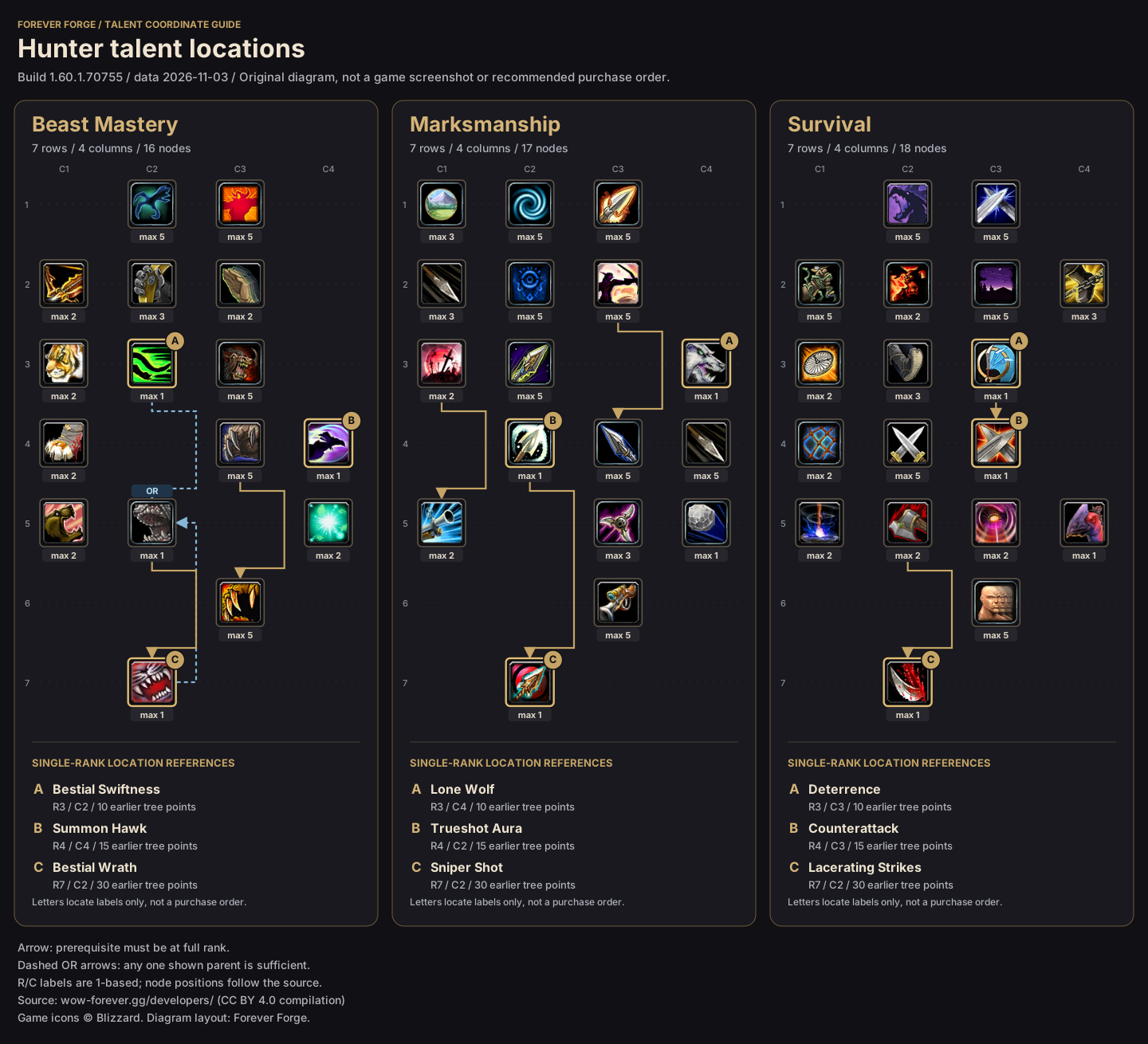
Talent location map
Original diagram of the reference trees. Locations and prerequisites are shown; this is not a recommended purchase order. Talent names follow the English export.

WoW Forever Hunter Guide · Leveling
Set up companion control
- Keep attack, follow and passive controls reachable.
- Practice single targets and watch when attention moves between you and the pet.
Recovering control matters before trying ambitious pulls.
Choose the companion relationship
- Inspect Beast Mastery if the pet is the main attraction.
- Read Lone Wolf before selecting it and change your safety plan accordingly.
Similar ranged weapons can support very different routines.
Make pulls intentional
- Recall before shortcuts and uncertain terrain.
- Respect marked targets and agree where traps are useful.
Preventing an accidental fight can matter more than another damage button.
Choose the routine rather than the reputation
Before deciding Hunter is the easiest or fastest class, ask whether you enjoy controlling another unit. A companion can make a fight easier to understand, but does not remove responsibility for what happens around a corner or on a crowded path. Practice sending it to one enemy, bringing it back and stopping an attack before adding more opponents. A comfortable control setup is a real advantage you can carry into group play.
Beast Mastery is the natural tree to inspect if companion play is why you chose the class. Marksmanship and Survival are alternative routines, not just different letters on a ranking. Lone Wolf changes the role of the pet, while Survival's current milestones support a melee identity. Keep that distinction in your class-picker result and the name of every saved build.
Connect solo practice with dungeon discipline
When leveling, inspect choices that improve the parts of combat you repeat: companion durability, damage with the pet active, movement and resource use. You do not need a final raid plan before understanding those basics. Save an early build with its purchase order, then change one branch when you can explain which problem it solves.
In a dungeon, recall before jumps and shortcuts, respect crowd-control targets and avoid spreading attacks into nearby enemies automatically. The published changes to traps and pet scaling create options, not permission to ignore the party's plan. A favorable solo recommendation also says nothing by itself about a specific level-60 damage ranking. Build for the environment you are entering.
Common mistakes and how to fix them
Letting a pet choose every target.
Use deliberate attack and recall commands, especially around marked enemies.
Taking Lone Wolf while keeping a pet-tanking plan.
Revisit distance, control and recovery when the pet is absent.
Assuming Survival is unchanged from Classic.
Inspect Forever's actual melee milestones and weapon requirements.
Race & class combinations
Both Skyborne variants can be Hunters; their other class options differ.
| Alliance | Horde |
|---|---|
| Dwarf, Human, Night Elf, Skyborne High Order | Orc, Tauren, Troll, Skyborne Windshaper |
Common questions
Does every Hunter build need a pet?
The current Marksmanship tree includes Lone Wolf. Treat it as a different routine and read its current tooltip.
Is Survival the old ranged Classic build?
Forever's published changes and current talents support a melee-oriented route. Compare the tree rather than transferring its name alone.
What should I practice first?
Pet attack, passive and recall commands, single-target pulls and safe positioning.
How should I choose between Beast Mastery and Marksmanship?
Inspect Beast Mastery when the companion is central to your preferred routine. Compare Marksmanship when ranged shots or its Lone Wolf option attract you. Check who will handle enemy pressure before removing the pet from a plan that previously relied on it.
Can both Skyborne factions play Hunter?
Yes. The official matrix allows both High Order and Windshaper Skyborne to be Hunters. Their other class options differ, so this does not make the two faction variants interchangeable.
What should I do if my pet reaches an unintended group?
Stop unwanted attack orders, recall deliberately and tell your party which enemies have joined the encounter. Afterwards check the path, shortcut or automatic target command. A new damage talent does not repair the same repeated movement mistake.
Sources
- Create the Hero You Want to Be · Checked 2026-11-04
- Hunter and Druid Class Deep Dives · Checked 2026-11-04
- Talent export: 1.60.1.70755 · Checked 2026-11-04
- Hunter guide (structure reference) · Checked 2026-11-04